

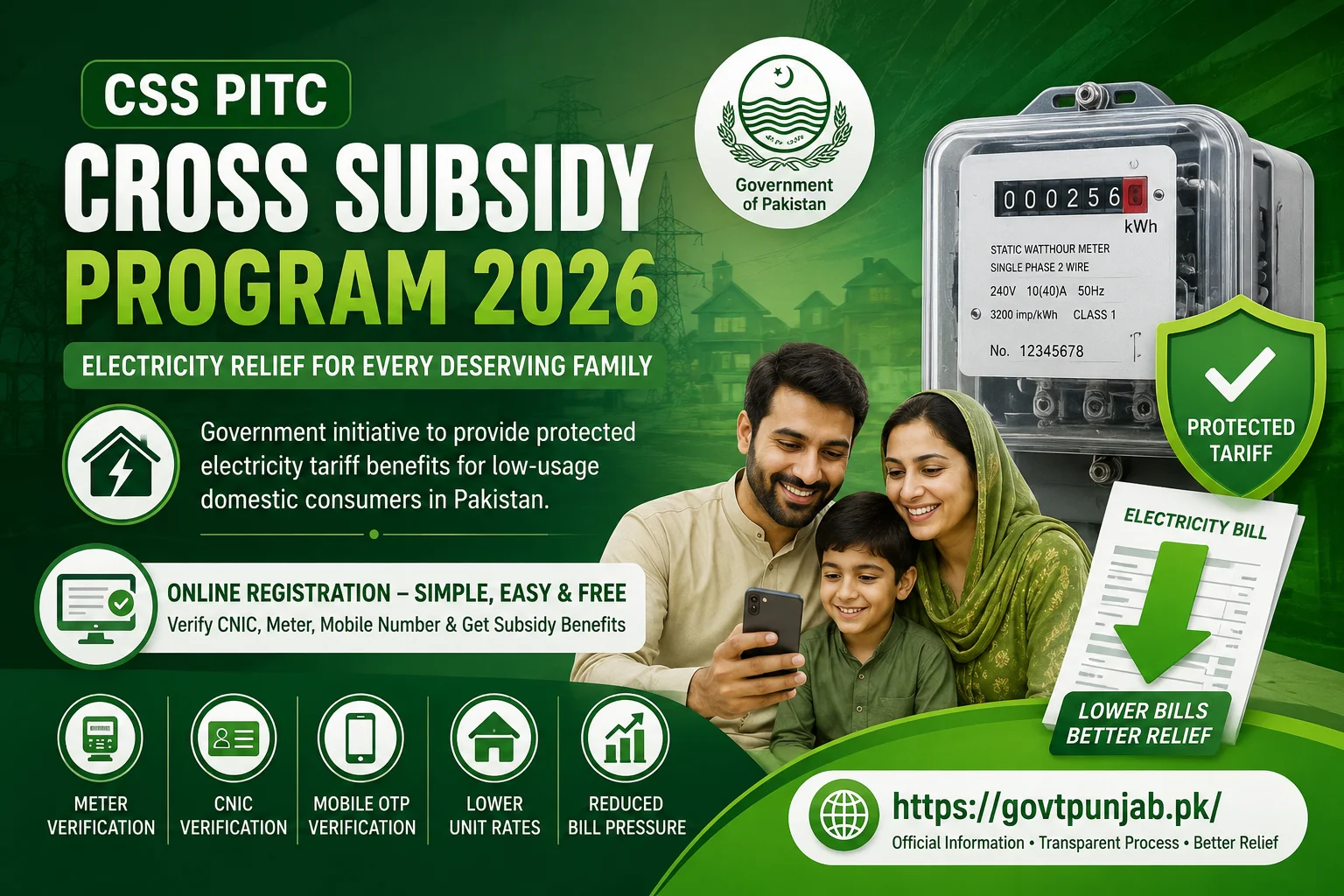
CSS PITC Cross Subsidy Program is a digital electricity relief verification system launched to help low-income and deserving domestic consumers in Pakistan receive protected electricity tariff benefits. Due to continuously increasing electricity prices, many households are struggling to manage monthly utility expenses.
To support such families, the government introduced the Cross subsidy program 2026 pakistan through the PITC digital platform. Families already receiving financial support like the BISP Payment 14500 scheme can also check their eligibility for electricity subsidy relief under this initiative.
This system verifies electricity meters, CNIC details, mobile numbers and household information to ensure that subsidy benefits reach genuine low-usage domestic consumers instead of commercial users or fake registrations.
Through the Cross subsidy program 2026 online registration, eligible households may receive lower electricity unit rates and reduced billing pressure. The registration process is completely online, simple and free for domestic users. Today, searches related to Cross subsidy program registration, Cross subsidy program pitc and Pitc subsidy program are rapidly increasing as more Pakistani families look for legal ways to reduce electricity bills.
What Is CSS PITC Cross Subsidy Program?
CSS PITC Cross Subsidy Program is a government-supported electricity relief initiative managed through the PITC digital system in Pakistan.
The purpose of this program is to ensure that electricity subsidy benefits reach deserving low-consumption domestic households instead of commercial users, vacant properties or consumers misusing domestic meters.
The system verifies different details together, including:
- Electricity meter information
- CNIC verification
- Mobile number verification
- Household occupancy details
- Electricity consumption history
Through this verification system, the government tries to identify genuine low-usage households that qualify for protected electricity tariff benefits.
Today, searches related to Cross subsidy program 2026 online registration, Cross subsidy program pitc and Pitc subsidy program are increasing rapidly because more consumers want relief from rising electricity bills.
Why CSS PITC Cross Subsidy Program Is Important in Pakistan
Electricity expenses have become a serious issue for millions of Pakistani families. During summer, even small increases in electricity units can significantly raise monthly bills.
In many areas, people regularly discuss how to stay within protected unit limits because crossing certain slabs increases electricity charges heavily.
For low-income households, even small savings on utility bills can help manage:
- Grocery expenses
- Children’s education costs
- Medicine purchases
- Gas and internet bills
- Daily household needs
This is one major reason why the Cross subsidy program 2026 pakistan is becoming increasingly important for domestic consumers.
Families who successfully complete verification through the PITC system may receive protected tariff benefits that reduce electricity costs legally.
How CSS PITC Cross Subsidy Program Works
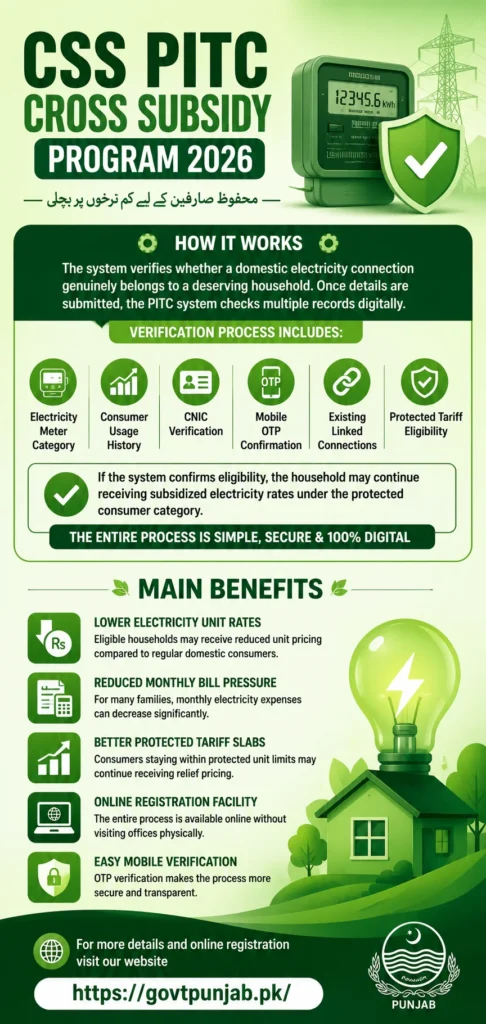
The system works by verifying whether a domestic electricity connection genuinely belongs to a deserving household. Once a consumer submits the required details, the PITC system checks multiple records digitally.
The verification process includes:
- Electricity meter category
- Consumer usage history
- CNIC verification
- Mobile OTP confirmation
- Existing linked connections
- Protected tariff eligibility
If the system confirms eligibility, the household may continue receiving subsidized electricity rates under the protected consumer category.
The entire Cross subsidy program 2026 online registration process is designed to be simple and fully digital.
Main Benefits of CSS PITC Cross Subsidy Program
Many consumers are now searching for Cross subsidy program registration because of the possible financial relief offered under protected tariff categories.
Some major benefits include:
Lower Electricity Unit Rates
Eligible households may receive reduced unit pricing compared to regular domestic consumers.
Reduced Monthly Bill Pressure
For many families, monthly electricity expenses can decrease significantly.
Better Protected Tariff Slabs
Consumers staying within protected unit limits may continue receiving relief pricing.
Online Registration Facility
The entire process is available online without visiting offices physically.
Easy Mobile Verification
OTP verification makes the process more secure and transparent.
Eligibility Criteria for CSS PITC Cross Subsidy Program
One common misunderstanding is that every domestic electricity consumer automatically qualifies for subsidy benefits. However, the PITC system checks multiple conditions before approval.
Below are the main eligibility requirements for the Cross subsidy program pakistan online registration process.
Domestic Electricity Connection
Your electricity meter must be registered under the domestic tariff category.
Commercial or industrial meters usually do not qualify.
Low Electricity Consumption
Households generally need to maintain lower electricity usage, commonly near protected limits such as around 200 units monthly.
Higher usage may affect eligibility status.
Valid CNIC Verification
Consumers must provide correct CNIC information during registration.
Incorrect CNIC details may cause verification failure.
Active Mobile Number
The system requires an active mobile number for OTP verification.
Biometric-verified SIM cards usually work better.
Single Active Connection Rule
One CNIC generally cannot remain linked with multiple domestic electricity connections simultaneously.
If multiple connections are associated with one CNIC, the system may reject the application.
How to Apply for CSS PITC Cross Subsidy Program 2026
Many people think the Cross subsidy program 2026 registration process is difficult, but honestly it usually takes only a few minutes if your information is correct.
Below is the complete step-by-step process.
Step 1: Open Official PITC Portal
Visit the official PITC subsidy portal using your mobile phone or computer browser.
Always use official websites because fake PITC pages are spreading on WhatsApp, Facebook, and YouTube.
Never trust unknown links shared in random groups.
Step 2: Enter Electricity Reference Number
The portal will ask for your electricity bill reference number.
This reference number is printed on the top section of your electricity bill.
Many consumers mistakenly enter Customer ID instead of Reference Number, which causes verification problems.
Always enter the correct 14-digit reference number carefully.
Step 3: Verify Consumer Information
After entering the reference number, the system may display:
- Consumer name
- Meter address
- Tariff category
- Electricity company details
- Sanctioned load
This step helps verify the authenticity of the electricity connection.
Step 4: Enter CNIC and Mobile Number
Now the system asks for:
- CNIC number
- Active mobile number
The mobile number should ideally be registered under your own CNIC.
This step connects the household with the verified occupant
Step 5: Complete OTP Verification
The PITC portal sends an OTP code through SMS.
Enter the OTP correctly to complete verification.
This step helps prevent fake registrations and unauthorized applications.
Step 6: Submit Application
After successful OTP verification, your application enters the subsidy verification process.
The system then checks your eligibility automatically.
What Happens After Registration?
After completing the Cross subsidy program 2026 online registration, the PITC system reviews your data in the background.
If your household qualifies:
- Protected tariff benefits may activate
- Electricity unit rates may reduce
- Future bills may show lower charges
Some families notice changes from the very next billing cycle, while others may require additional verification time.
What Is Protected Electricity Tariff?
Protected tariff is a special electricity pricing category for low-consumption domestic consumers.
Eligible households may receive:
- Lower per-unit electricity charges
- Reduced fuel adjustment impact
- Lower fixed charges
- Better slab pricing protection
For many Pakistani families, yearly savings can become very significant.
Common Problems During CSS PITC Registration
Many consumers face similar issues during the registration process.
Below are the most common problems and their solutions.
OTP Not Received
This problem usually happens because of:
- Weak mobile signals
- Incorrect phone number
- Heavy portal traffic
- Network delays
Simple Solution
- Wait a few minutes
- Check signal strength
- Avoid requesting OTP repeatedly
- Try again during non-peak hours
Verification Failed Error
This error may appear because of:
- Incorrect CNIC information
- Wrong reference number
- Multiple meters linked with one CNIC
- Electricity usage above protected limit
Simple Solution
Double-check all details carefully before resubmitting the application.
PITC Portal Not Working
Government portals sometimes slow down during heavy traffic periods.
Simple Solution
- Refresh the page
- Clear browser cache
- Use another browser
- Switch mobile network
- Apply late at night
Many users report smoother performance during non-peak timings
Electricity Companies Supported Under PITC System
The Cross subsidy program pitc system supports multiple electricity distribution companies across Pakistan.
Supported DISCOs include:
- MEPCO
- LESCO
- FESCO
- IESCO
- GEPCO
- PESCO
- HESCO
- SEPCO
- QESCO
- TESCO
- HAZECO
The system automatically detects your electricity company using your reference number.
Consumers searching for Cross subsidy program 2026 karachi can also apply if their electricity connection falls under supported systems.
Important Safety Tips for Pakistani Consumers
Due to increasing popularity of the subsidy system, fake websites and fraudulent agents are also targeting consumers online.
Follow these safety tips carefully.
Use Official Portal Only
Never submit your CNIC or electricity details on random websites.
Never Share OTP Codes
OTP codes should remain private.
Sharing OTPs may create security risks.
Avoid Fake Facebook Pages
Many fake pages promise guaranteed approvals or quick subsidy activation.
These claims are usually misleading.
Do Not Pay Agents
Official PITC registration is completely free.
No authorized person should demand money for:
- Fast approval
- Guaranteed eligibility
- Priority processing
Why Monitoring Electricity Usage Is Important
After registration, consumers should continue monitoring monthly electricity usage carefully.
If usage crosses protected limits regularly, subsidy benefits may reduce or stop completely.
Many Pakistani households now actively manage electricity usage by:
- Using energy saver appliances
- Switching off unnecessary lights
- Reducing AC usage
- Monitoring summer electricity units
- Avoiding excessive peak-hour consumption
This helps maintain protected tariff eligibility for longer periods.
Tips to Stay Eligible for Subsidy Benefits
Below are some practical tips for Pakistani households.
Keep Monthly Units Under Control
Avoid crossing protected slab limits unnecessarily.
Use Correct Consumer Information
Always provide accurate CNIC and mobile details.
Avoid Multiple Connections on One CNIC
This may create verification issues.
Check Bills Regularly
Monitor whether protected tariff benefits remain active.
Save Registration Screenshots
Keep proof of successful application submission.
Is CSS PITC Registration Free?
Yes, the Cross subsidy program registration process is completely free.
No government officer or authorized person should demand payment for:
- Fast approval
- Guaranteed eligibility
- Priority verification
- Instant subsidy activation
Consumers should avoid scammers offering paid approval services.
Difference Between Protected and Non-Protected Consumers
Many Pakistani consumers still do not fully understand this difference.
Protected Consumers
- Lower electricity unit rates
- Lower fuel adjustment impact
- Better subsidy support
- Lower monthly bills
Non-Protected Consumers
- Higher per-unit rates
- Higher taxes and adjustments
- Increased monthly electricity costs
Even small increases in monthly units can move consumers into non-protected categories.
Conclusion
CSS PITC Cross Subsidy Program has become one of the most important electricity relief systems for low income and deserving households in Pakistan. With rising electricity prices, protected tariff benefits can provide meaningful financial support to families struggling with monthly utility expenses.
The registration process is not difficult, but consumers must enter accurate information and complete OTP verification carefully. Using the official portal, verifying your CNIC correctly and monitoring monthly electricity usage can help households continue receiving subsidy benefits legally.
If your household genuinely qualifies, prepare your electricity bill, CNIC and active mobile number before starting the registration process. Avoid fake agents, unofficial WhatsApp links and fraudulent PITC websites.
Cross subsidy program 2026 pakistan online registration system is designed to make subsidy access easier for ordinary Pakistani families and understanding the process properly can help many households reduce electricity bill pressure in 2026 and beyond.
Frequently Asked Questions
What is CSS PITC Cross Subsidy Program?
CSS PITC Cross Subsidy Program is a government-supported electricity subsidy verification system for low-usage domestic consumers in Pakistan. It helps deserving households receive protected electricity tariff benefits through online verification.
Is Cross Subsidy Program 2026 registration free?
Yes, the complete Cross subsidy program 2026 online registration process is totally free through the official PITC portal.
Who can apply for PITC subsidy program?
Domestic consumers with low electricity usage, valid CNIC and eligible residential connections can apply.
Why is OTP verification important?
OTP verification confirms genuine household registration and prevents fake applications.
What if CSS PITC portal is not working?
Try refreshing the page, changing browser, clearing cache or applying during late-night hours when portal traffic is lower.
